

Data security compliance is no longer governed by a single rule or regulator. For many businesses—especially tax, accounting, and financial firms—multiple laws apply at the same time. One of the most misunderstood is the New York SHIELD Act, which often overlaps with the IRS Safeguards Rule and the FTC Safeguards Rule, but is not the same.
Understanding how these regulations differ—and how they work together—is critical to managing risk and staying compliant.
The good news: with the right Written Information Security Plan (WISP), you can address all three requirements in one place.
What Is the NY SHIELD Act?
The NY SHIELD Act (Stop Hacks and Improve Electronic Data Security Act) is a New York State law that requires organizations to implement reasonable administrative, technical, and physical safeguards to protect the private information of New York residents.
Unlike federal rules, the SHIELD Act:
- Applies to businesses inside or outside New York
- Covers a broad range of personal data
- Focuses on whether safeguards are reasonable and documented
If your business handles personal data belonging to New York residents, the SHIELD Act likely applies to you—even if you are not based in New York.
How the SHIELD Act Differs from IRS and FTC Safeguards
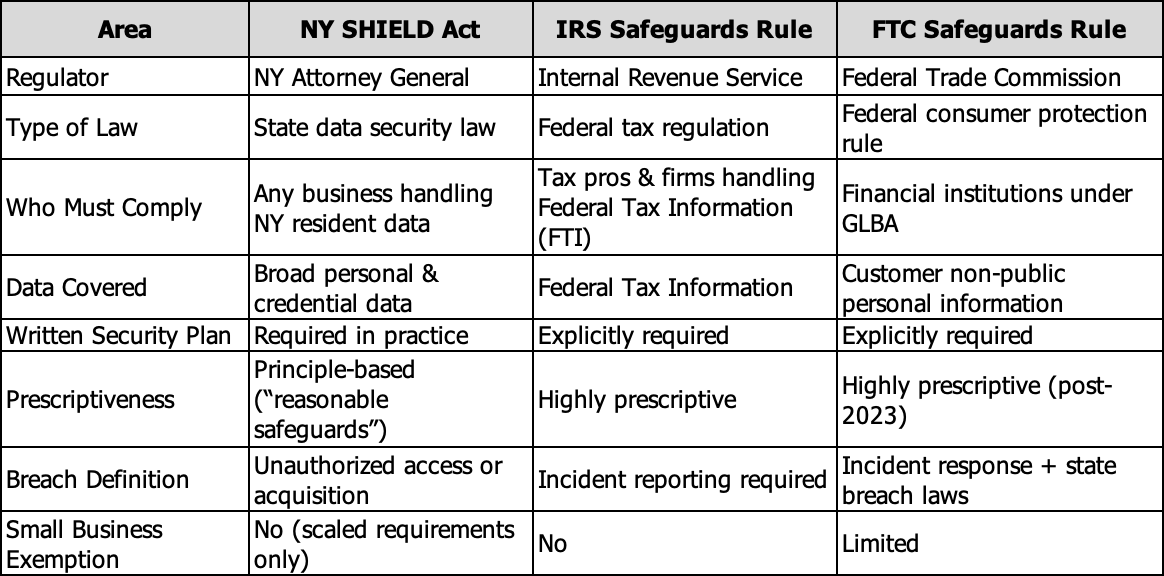
Although the SHIELD Act, IRS Safeguards Rule, and FTC Safeguards Rule all address data security, they were created for different purposes and are enforced differently.
What Makes the NY SHIELD Act Unique
The SHIELD Act is different from federal safeguards rules in several important ways:
-
Broader Applicability
The SHIELD Act applies to any organization that owns or licenses private information of New York residents—regardless of industry. IRS and FTC rules apply only to specific regulated activities.
-
Broader Data Definition
SHIELD includes data types not always emphasized in federal rules, such as:
-
Login credentials
-
Biometric information
-
Certain digital identifiers
-
Outcome-Focused Enforcement
Rather than prescribing exact controls, the SHIELD Act evaluates whether your safeguards are reasonable, appropriate, and documented. If you cannot show written policies and procedures, compliance becomes difficult to defend.
How IRS and FTC Safeguards Raise the Bar
While the SHIELD Act is broad, the IRS and FTC Safeguards Rules are more detailed.
- The IRS Safeguards Rule focuses specifically on protecting Federal Tax Information and is tied directly to your ability to operate as a tax professional.
- The FTC Safeguards Rule, especially after recent updates, requires formal governance, risk assessments, monitoring, and reporting.
In practice, these federal rules establish a higher technical and documentation standard than the SHIELD Act alone.
One WISP Can Cover All Three
Many firms mistakenly believe they need separate compliance programs for each regulation. In reality, a well-designed Written Information Security Plan (WISP) can satisfy:
- NY SHIELD Act safeguard requirements
- IRS Safeguards Rule documentation expectations
- FTC Safeguards Rule administrative, technical, and physical controls
The key is ensuring the WISP is:
- Written and structured
- Risk-based
- Updated and reviewable
- Aligned with regulatory language
- Ironclad in defense of publication & acknowledgement
How WISPBuilder.com Helps
WISPBuilder.com was designed specifically to help businesses meet overlapping security requirements without unnecessary complexity.
Using WISP Builder, organizations can:
- Create a compliant Written Information Security Plan
- Address administrative, technical, and physical safeguards
- Support IRS, FTC, and NY SHIELD Act requirements in one framework
- Maintain documentation and e-signature acknowledgements that stands up to audits and inquiries
- Stores the WISP offsite in a secure and encrypted location
Rather than juggling multiple policies or templates, WISP Builder provides a single, guided solution that aligns with all three regulatory standards.
Final Takeaway
If your business handles taxpayer data, customer financial information, or New York resident personal data, you are likely subject to more than one data security rule.
- The NY SHIELD Act expands who must protect data
- The IRS Safeguards Rule protects tax information
- The FTC Safeguards Rule governs financial customer data
A comprehensive Written Information Security Plan is no longer optional—it is the foundation of compliance.
WISPBuilder.com makes it possible to meet all three requirements with one practical, defensible solution.